First signs of SDCA1
4.5–8.5weeks of age
Affected puppies lose their balance and fall, from a few weeks old.[4]

Joints, eyes, two puppy brain diseases and seizures: what to see on paper for both parents.
A Malinois runs, turns and jumps hard all its life, so hips and elbows matter: the Royal Kennel Club lists both as best-practice screening for the breed, and the American breed club recommends hip, elbow and eye evaluations. Joint health, injuries from hard work and play, and a lean body all affect how long and how well a working dog lives. KUSA tells buyers to see the parents' results before paying any deposit.[1][2][3]

Affected puppies lose their balance and fall, from a few weeks old.[4]
And the microchip number must appear on the x-ray.[5]
The American breed club tells buyers to plan for 14 to 16 years.[1][6]
From the SDCA research papers, the SAVA and KUSA scheme and the Royal Kennel Club. No Malinois-specific life-span study was found.
Ask for a copy of each certificate before any deposit. Check that the dog's name, registration number and microchip match the parent you are shown, and that the hip and elbow certificate comes from a SAVA and KUSA panel radiologist. 'Tested' or 'health checked' is the breeder's own claim until you have seen the papers.
On the mother and the father:
Signs of thorough screening:
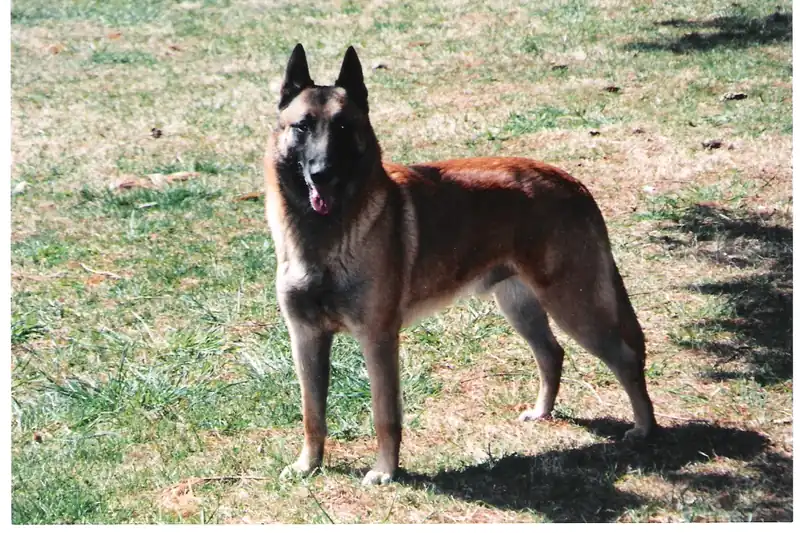
Hip and elbow dysplasia are uneven growth of the joint that can lead to pain and arthritis. The Royal Kennel Club lists hip and elbow screening as best practice for the Malinois, and the American breed club's recommended tests are hips, elbows and an eye examination.
In South Africa the parents should be x-rayed under the SAVA and KUSA scheme from 12 months. For a puppy, free play on soft ground suits growing joints; ask your vet before long runs, jumping or running beside a bicycle.[1][2][5]

Spongy degeneration with cerebellar ataxia is a severe inherited brain disease seen in Malinois puppies: affected puppies lose their balance and fall, with signs from about 4.5 to 8.5 weeks of age. Researchers found two separate forms. For SDCA1 the most likely cause is a change in the KCNJ10 gene, and for SDCA2 an insertion in the ATP1B2 gene.
Both are inherited recessively, so a puppy is affected only if it receives a copy from each parent, and the findings give the basis for DNA tests. Ask whether both parents have SDCA1 and SDCA2 results.[4][8]

Idiopathic epilepsy has been studied in Belgian Shepherd dogs, and researchers found a low-penetrance risk gene, ADAM23. That raises risk without deciding it, so the most useful thing a buyer can do is ask honestly about seizures in the parents, grandparents and earlier litters.
An eye examination under a recognised scheme is part of the breed's screening in the UK and the US. Ask for the written result for both parents.[9][1][2]
Under the SAVA and KUSA scheme, hips run from A1, the best, to E2. C, D and E mean mild, moderate and severe dysplasia. Elbows run from 0, normal, to 3.[7][5]
From 12 months of age, with the microchip number on the x-ray.[5]
Signs appear early, at about 4.5 to 8.5 weeks: loss of balance and falling. Any puppy that wobbles needs a vet at once.[4]
No. It shows today's health. It cannot show the parents' joints, eyes or SDCA status, which is why the parents' certificates matter.[3][5]
No one can. A careful breeder screens both parents, shows the certificates and stays in touch. Keep a copy of any written health promise and read it closely.
Written from the sources above for Premier Pets. Last reviewed 27 November 2026. Spot something out of date? Email sales@premierpets.co.za.